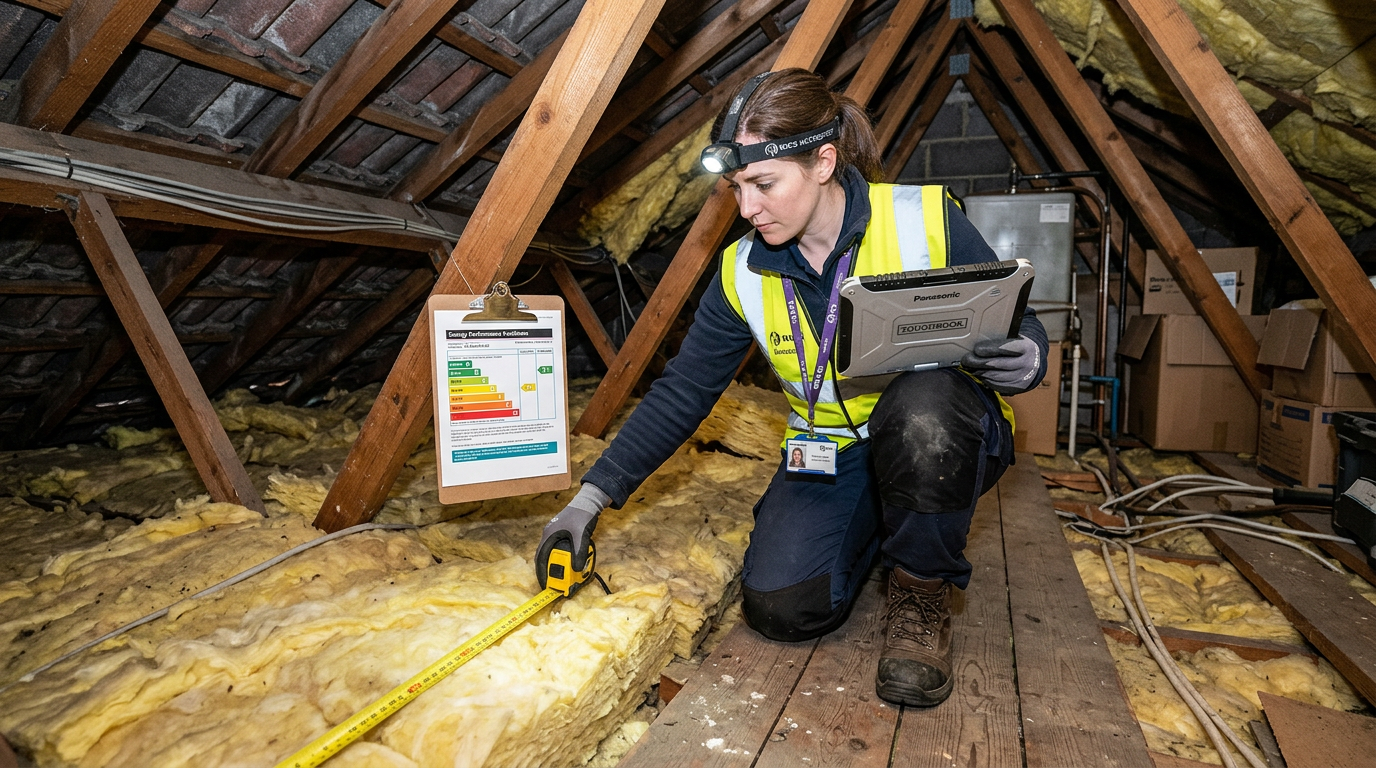
If you're buying, selling or renting a property in Watford, you've almost certainly come across the term Energy Performance Certificate — or EPC. But what exactly is an EPC, why does it matter, and how does it affect your property's value? As RICS surveyors who work with Watford and Hertfordshire homeowners every day, we answer these questions constantly. This guide covers everything you need to know.
What Is an Energy Performance Certificate (EPC)?
An Energy Performance Certificate (EPC) is a document that rates the energy efficiency of a property on a scale from A (most efficient) to G (least efficient). It also provides an estimate of the property's typical energy costs and gives recommendations for improving its energy efficiency.
EPCs are produced by accredited domestic energy assessors who carry out an inspection of the property and use the Standard Assessment Procedure (SAP) to calculate the rating. The certificate is valid for ten years and must be lodged on the national EPC register.
In Watford and across the UK, EPCs are legally required whenever a residential property is sold, let or built. The EPC must be made available to prospective buyers or tenants at the earliest opportunity — it's not something you can delay until after a sale is agreed.
EPC Ratings: What Do They Mean?
The EPC rating system works as follows:
- A (92–100): Extremely energy efficient — very low running costs. Rare in older British housing stock.
- B (81–91): Very good energy efficiency. Typically modern, well-insulated new-build homes.
- C (69–80): Good efficiency. Modern or well-upgraded homes. The government's target for all homes by 2035.
- D (55–68): Average efficiency. The most common rating in the UK and across Watford's housing stock.
- E (39–54): Below average. Common in older, Victorian and Edwardian properties without modern insulation.
- F (21–38): Poor efficiency — high running costs. Many buyers will factor improvement costs into their offer.
- G (1–20): Very poor. Since 2020, landlords can no longer let residential properties rated F or G.
The average EPC rating for UK homes is D. Given the high proportion of Victorian terraces, Edwardian semis and inter-war housing in Watford and south Hertfordshire, a D or E rating is extremely common in this area. Don't panic if the property you're buying has an E rating — it's very common and doesn't necessarily mean it's cold or expensive to run. But it is worth understanding what improvements might push the rating up.
When Is an EPC Legally Required?
An EPC is legally required in the following situations:
- When a property is put up for sale
- When a property is put up for rent
- When a property is newly built or has undergone a change of use
- When applying for certain government grants and retrofit schemes
Exemptions exist for listed buildings (where energy efficiency improvements might harm the character of the building), some temporary buildings, and certain industrial or agricultural properties.
EPCs and Rental Properties in Hertfordshire: MEES Regulations
The Minimum Energy Efficiency Standards (MEES) regulations have significantly tightened the rules for landlords. Since April 2020, landlords in England and Wales — including throughout Hertfordshire — cannot grant a new tenancy (or renew an existing one) for a property with an EPC rating of F or G.
The government has been considering raising this threshold to a minimum EPC of C for new tenancies by 2025 and all tenancies by 2028, though these plans have been subject to significant debate. As a Watford landlord, it's essential to stay on top of this changing landscape. Many of the older Victorian and Edwardian terraced houses popular in the Watford buy-to-let market are currently rated D or E — improvement works may be required to bring them to C for future compliance.
At Watford Surveyors, our surveyors can advise landlords on the likely cost and feasibility of EPC improvements as part of a broader property assessment.
How Is an EPC Assessment Carried Out?
An EPC assessment typically takes 45 minutes to 1.5 hours for a standard residential property. The assessor will look at:
- The age, type and construction of the property (detached, semi, terrace, flat)
- The type of heating system and fuel used
- Wall insulation — cavity fill, solid wall external or internal insulation
- Loft insulation — thickness and coverage
- Floor insulation if present
- Double or triple glazing
- Lighting (proportion of energy-efficient fittings)
- Renewable energy sources — solar panels, heat pumps, etc.
Importantly, the assessor does not test all these features themselves — the assessment is largely based on visual observation and the property's age and construction type. For this reason, it's worth making sure the assessor is aware of any upgrades that may not be immediately visible, such as solid wall insulation or underfloor insulation installed during a renovation.
Does an EPC Affect Property Value in Watford?
Increasingly, yes. Research from Rightmove and other industry sources has found that properties with higher EPC ratings (A or B) typically sell for a premium compared to equivalent properties with lower ratings. In practical terms for the Watford market:
- A property improved from E to C may see a value uplift of 5–10% in certain markets
- An F or G-rated property may struggle to attract mortgage finance from some lenders
- Buy-to-let investors are increasingly factoring in EPC improvement costs when calculating return on investment
When we carry out a RICS Level 2 or Level 3 Building Survey, we will comment on visible energy efficiency features and flag any issues that are likely to be affecting the EPC rating. This gives buyers a much more complete picture of what they're buying and what improvements might be worthwhile.
How to Improve Your EPC Rating
For most Watford and Hertfordshire homes rated D, E or F, the most impactful improvements are:
1. Loft Insulation
Adding or topping up loft insulation to 270mm is one of the most cost-effective energy efficiency improvements available. Cost: typically £300–£500 if not already done. Potential rating improvement: up to 2–3 EPC points.
2. Cavity Wall Insulation
Most homes built between the 1920s and 1990s have cavity walls that can be insulated. Cost: typically £400–£600 for a semi-detached house. Potential rating improvement: significant — often 5+ EPC points.
3. Double Glazing
Replacing single glazing with double or triple glazing improves both energy efficiency and EPC rating. Modern secondary glazing can be a cost-effective alternative for listed buildings or conservation area properties where replacement windows may not be permitted.
4. Heating System Upgrade
A modern condensing boiler can make a significant difference. Heat pumps (air source or ground source) can push ratings into the A or B band, though installation costs are higher. Government grants (the Boiler Upgrade Scheme) may be available.
5. Solar PV Panels
Adding solar photovoltaic panels can significantly improve an EPC rating and reduce energy bills. Feed-in and export payments provide an income stream. For many Hertfordshire homes with south-facing roofs, this is an attractive investment.
EPC vs Building Survey: What's the Difference?
This is a question we get asked often at Watford Surveyors. It's important to understand that an EPC is not a structural survey. It tells you about energy efficiency — not the physical condition of the building. It won't tell you about:
- Structural cracking, subsidence or settlement
- Damp (other than as a very general observation)
- Roof condition
- Drainage problems
- Electrical or plumbing issues
You need a RICS Level 2 Home Survey or Level 3 Building Survey for that. Both types of survey serve completely different purposes, and both are important when buying a property in Watford or Hertfordshire.
EPC Frequently Asked Questions
How long is an EPC valid for in Watford?
An EPC is valid for 10 years. If the property already has a valid EPC registered on the national database, this can be used for a sale or letting — you don't necessarily need a new one. However, if significant energy efficiency improvements have been made since the last EPC, it may be worth commissioning a fresh one to reflect the improved rating.
How much does an EPC cost in Hertfordshire?
EPC assessments for standard residential properties in Hertfordshire typically cost between £60 and £120. Prices vary depending on the assessor and the size of the property. Some estate agents include the EPC cost within their commission when handling a sale. Our team at Watford Surveyors can advise on accredited local assessors.
What EPC rating do I need to rent out my Watford property?
Under the current MEES regulations, you need a minimum EPC rating of E to grant or renew a residential tenancy in England. Properties rated F or G cannot be lawfully let unless a valid exemption applies (e.g., all cost-effective measures have been implemented or consent is withheld). The government has proposed raising this to C, though the timeline remains subject to consultation.
Does a listed building need an EPC?
Listed buildings and buildings within conservation areas are generally exempt from the requirement to have an EPC where compliance with energy efficiency requirements would "unacceptably alter their character or appearance." However, this exemption isn't automatic — it applies case by case. If you own or are buying a listed building in Hertfordshire, seek specialist advice on your specific obligations.
Can I challenge a low EPC rating on my Watford property?
Yes. If you believe the assessor made an error — for example, if they missed installed insulation or recorded the wrong heating system — you can raise a complaint through the assessor's accreditation body. You can also commission a new EPC from a different accredited assessor. Keeping records of any energy efficiency improvements (invoices, building regs certificates) makes it much easier to ensure a fair rating.
Talk to Watford Surveyors About Your Property's Energy Efficiency
Whether you're buying a property and want to understand what EPC improvements might be needed, or you're a Hertfordshire landlord trying to navigate MEES compliance, our team at Watford Surveyors is here to help. Our RICS building surveys give you a far more complete picture of your property's condition than an EPC alone — covering structural issues, damp, drainage, roofing and much more.
Explore our full range of surveying services or contact us today for a no-obligation quote.
Get a Comprehensive Property Survey in Watford
Don't rely on the EPC alone. Our RICS Level 2 and Level 3 surveys give you the full picture before you buy or invest.
Get a Free Quote View All Services