Your building survey has come back and it's flagged some issues. Now what? This is the moment many buyers in Watford and Hertfordshire freeze — unsure what to do next. Should you pull out? Try to renegotiate? Just accept it and move on?
In this guide, our RICS surveyors at Watford Surveyors walk you through exactly how to use your survey report to negotiate effectively — whether that means getting money off the price, asking for repairs, or deciding whether to walk away.
🔑 Key Takeaways
- Finding problems in a survey is normal — don't panic
- Use repair cost estimates from your survey to justify any price reduction request
- Be reasonable and professional — sellers are more likely to negotiate if you approach it calmly
- Know your walk-away point before you start negotiating
- Your surveyor can help you understand what's serious and what's minor
Step 1: Understand Your Survey Report Properly
Before you do anything else, make sure you actually understand what your survey is saying. RICS survey reports use condition ratings: 1 (no action needed), 2 (monitor or repair when possible), and 3 (urgent attention required). Focus your attention on any Condition Rating 3 items first — these are your strongest leverage points.
Ring your surveyor and go through the report together. At Watford Surveyors, we include a post-survey telephone consultation with every survey as standard — this is exactly what it's for. Ask specifically: what are the most significant issues? What will they cost to fix? Which are likely to be structural versus cosmetic?
Step 2: Get Repair Cost Estimates
Your survey report may already include estimated costs for remedial work (this is standard in a Level 3 Building Survey and can be requested for a Level 2). If not, get two or three quotes from relevant trades — a roofer, a damp specialist, a structural engineer — before approaching the seller.
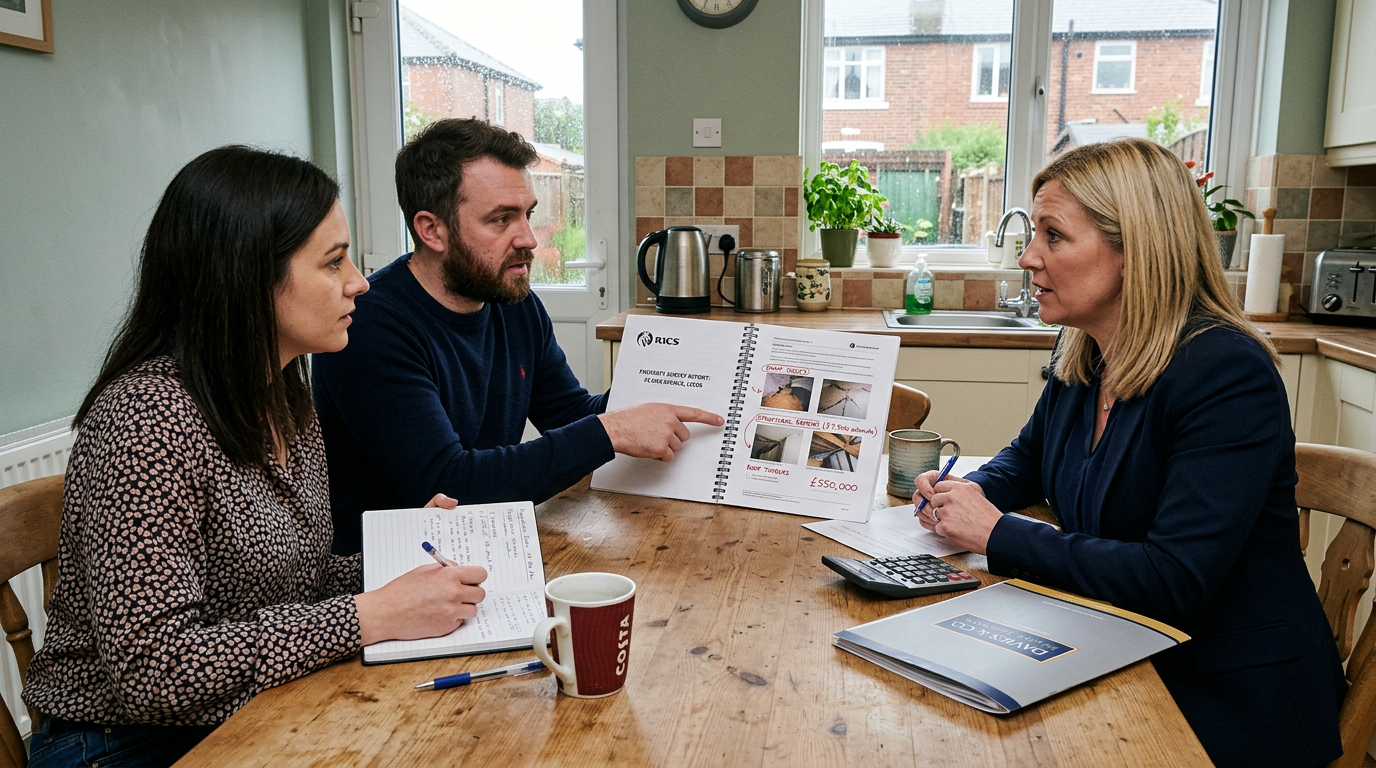
Having concrete cost estimates transforms a vague "the survey found some issues" into a specific, justified position: "The survey identified roof repairs estimated at £4,500 and rising damp remediation estimated at £3,200 — a total of approximately £7,700 in remedial works."
Step 3: Decide on Your Approach
You have three main options after receiving a survey showing defects:
- Ask for a price reduction — equivalent to the estimated cost of repairs. This is the most common approach and the simplest.
- Ask the seller to carry out the repairs before completion. This is often less preferable, as you have no control over the quality of the work.
- Walk away from the purchase — if the defects are severe, the cost is prohibitive, or you simply don't want to take on a project property.
Step 4: Make Your Case Professionally
Approach the negotiation through your estate agent. Provide a summary of the survey findings and the supporting cost estimates. Keep the tone professional and factual — you're not trying to screw the seller over, you're trying to reach a fair price that reflects the actual condition of the property.
A useful framing: "We remain keen to proceed, but having received the survey results and obtained repair estimates, we'd like to revisit the purchase price. We are proposing a revised offer of £X, which reflects the estimated cost of the works identified in the survey."
"In my experience, most sellers in Watford and Hertfordshire will engage with a reasonable renegotiation backed by survey evidence and repair estimates. What they won't accept is vague complaints with no substance. Numbers talk." — Sarah Mitchell, MRICS
Real Example: £14,000 Price Reduction in North Watford
One of our clients was purchasing a 1930s semi in north Watford. The Level 3 building survey identified: significant penetrating damp to the rear elevation (estimated repair: £5,500), failed cavity wall ties in the side elevation (estimated repair: £4,800), and a defective chimney stack requiring rebuilding (estimated repair: £3,800). Total: approximately £14,100.
Armed with the survey report and contractor quotes, the client submitted a revised offer. The seller came back at a £10,000 reduction — which the client accepted, netting a substantial saving and a clear understanding of what was needed.
When Should You Just Walk Away?
Sometimes the right decision is to pull out. This is worth considering when: the cost of remediation significantly exceeds what you can sensibly renegotiate; the property has structural issues that can't be properly quantified without expensive specialist reports; or the seller refuses to budge at all despite clear evidence of significant defects.
Walking away from a purchase is painful — you'll lose some legal and surveying fees — but it's far better than completing on a property that will cost you far more in the long run.
Need Help Understanding Your Survey Results?
Book a survey with Watford Surveyors and we'll walk you through every finding in plain English — and help you understand your negotiating position.
Related: Level 2 vs Level 3 survey | 10 warning signs of structural problems | Damp in Watford homes